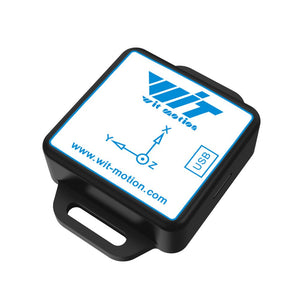
Vibration Sensors

Rolling bearings fail slowly. A vibration sensor buys you the weeks of warning you need to schedule a replacement instead of paying for an unplanned stop. These are triaxial units: one body measures vibration on all three axes at once, so a single mounting point covers the whole machine.

This range covers five ways to get that data out — wireless Bluetooth for walk-around surveys, RS485 Modbus for permanent plant monitoring, CAN where the vehicle bus already exists, and 4–20 mA / IEPE for the analogue inputs a PLC or DAQ already has.

Which vibration sensor do you need?

Model Signal out Range / bandwidth Mounting Best for
WTVB01-BT50 Bluetooth 5.0, wireless Triaxial, 50 m link, 8 h battery Magnetic base Walk-around surveys on machines that are hard to wire
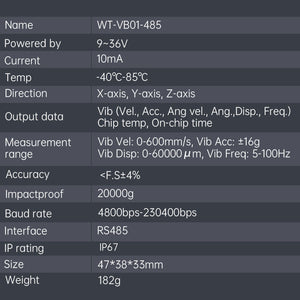
WTVB01-485 RS485 Modbus 0–100 mm/s velocity, 5–2000 Hz, IP67 Magnet or thread Permanent monitoring of motors and pumps
WTVB02-485 RS485 Modbus 0–60000 um displacement, IP68 Magnet or thread Heavy machinery where displacement is large
WTVB05 RS485 and CAN, dual bus Acceleration, amplitude, displacement, frequency; IP68 Threaded Vehicles and dual-bus plant integration
WTVB-10P / 50P / 503P / 501P IEPE / 4–20 mA analogue Piezoelectric element Stud mount Bearing faults and higher-frequency analysis

The three numbers that decide it

Bandwidth. General machine monitoring lives in 5–2000 Hz, which is what the WTVB01-485 covers. Bearing defects and gear meshing show up higher, which is where the piezoelectric models earn their price.

Output type. If you already have a PLC or SCADA system, RS485 Modbus drops straight in. If you have a vehicle CAN bus, WTVB05 talks to it directly. If your data logger only takes 4–20 mA, the IEPE range is the shorter path. Bluetooth exists for machines where pulling cable is not practical.

Range. A standard machine sits well inside 0–100 mm/s. When displacement is genuinely large — heavy rotors, loose foundations, big slow pumps — the WTVB02-485 goes to 60000 um before it clips.

Mounting decides the measurement

A loose sensor produces noise, not data. Magnetic bases are fast to move and fine for surveys and trending. Threaded or stud mounting is the right choice for permanent installations and for anything above a few kilohertz, because the magnet starts to damp the high frequencies you are trying to see. Every RS485 model here is available in both magnet and threaded versions, and the magnetic variants ship with 1, 5 or 10 metre leads.

What a vibration sensor costs

The wireless WTVB01-BT50 starts at $29 for survey work. The RS485 models sit in the $54–$108 range depending on housing and cable length, and the IEPE piezoelectric units run from about $138 upward as the element and output stage get more specialised. Cost tracks three things: whether you need a waterproof IP68 housing, whether you need CAN as well as RS485, and whether you need the frequency response of a piezoelectric element.

Integrating with a PLC or SCADA

The RS485 models expose a documented Modbus register map, so a PLC reads vibration values the same way it reads any other holding register. Nothing on this range needs proprietary software to produce a number — the PC software is there for configuration and trending, not as the only way in.

FAQ

Should I measure velocity, acceleration or displacement?

Velocity in mm/s is the usual general-purpose health indicator for rotating machines and is what the WTVB01-485 reports. Displacement suits low-speed machines where the excursion is large. Acceleration is best for bearings and high-frequency events. Several models here report more than one.

Can I mount it with a magnet?

Yes for surveys and trending. For permanent monitoring, thread it or stud-mount it — a magnet limits usable bandwidth and can shift over time.

How many sensors does one machine need?

One triaxial unit per bearing housing is the normal starting point, because it measures all three axes from a single mounting point. On a motor-pump set that usually means two: drive end and non-drive end.

Do these work with a Raspberry Pi or Arduino?

Not directly — the RS485 models need an RS485 transceiver on the other side. Our USB-to-RS485 converters handle the PC side, and any MCU with a Modbus library can read the registers.

Is there an OEM option?

For OEM integrations the RS485 models are the practical starting point: they use a standard Modbus register layout, so your own controller or gateway can read them without reverse engineering. Contact us with the machine type and the sampling rate you need and we will confirm the right variant.

Skip to product grid

5 products